Replumbing an improper trap.

2013-04-16 by . 5 comments

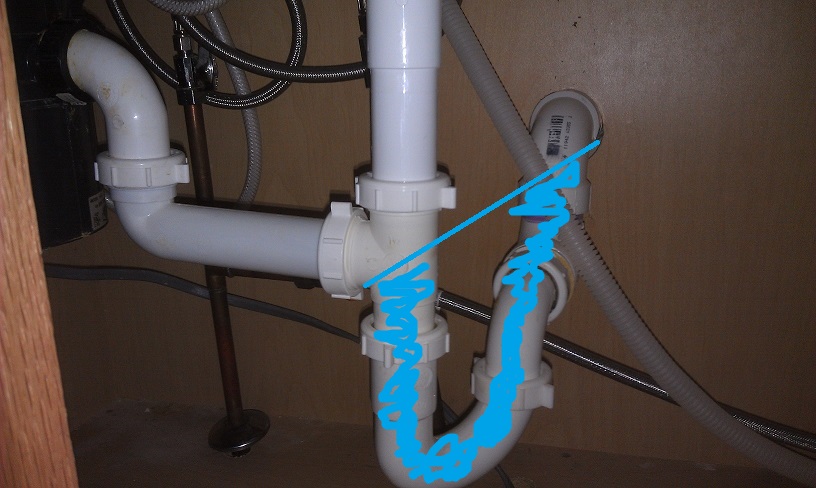
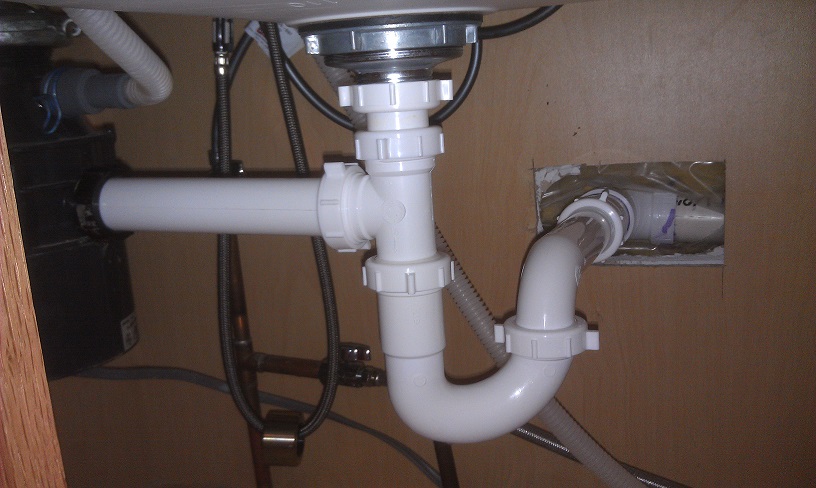
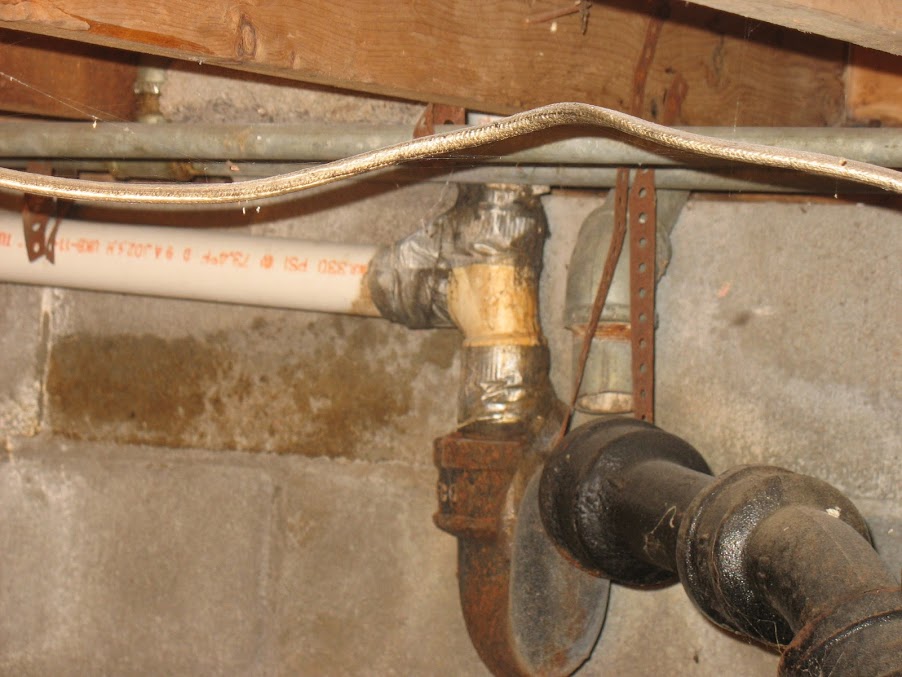
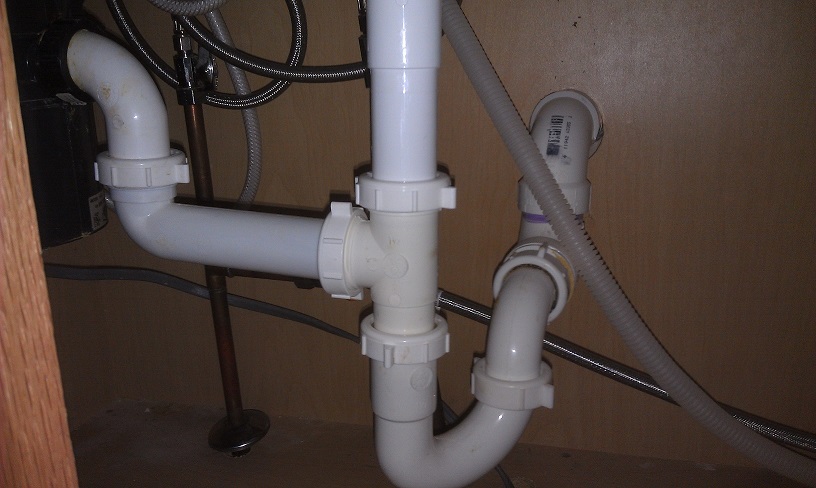
When I was inspecting the home that I recently purchased, I took a look under the kitchen sink and noticed this…

Bad Trap

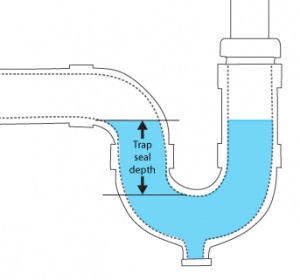
Typically, traps have a trap seal between 2 – 4 inches. This amount of water allows waste water and debris to flow down the drain, while still providing enough force to prevent sewer gases from pushing past. The problem you find with a deeper trap, is that the waste water; and in particular the debris, does not have enough force behind it to escape the trap. This leads to a nasty, dirty, stinkin’, slow flowing trap. Which leads to your wife saying “Dang, this sink stinks!”. If Google Nose BETA worked, I would have saved the smell from when the old trap was removed. Then you’d smell what I’m talking about.

Trap

If you take a look back at the first image, you’ll see that the trap seal is simply too large.  The entire pipe below the disposal drain line, all the way to the lower dip of the elbow coming out of the wall will be filled with water. Where in a normal situation, only the lower bend of the P-trap will be filled with water.

Bad Trap - Filled

Usually this situation is fixed easily by purchasing the correct fittings, and connecting them in a way that allows proper drainage. In my case, however, some genius glued a downward facing elbow at the outlet connection. As soon as this elbow was glued in place, the fate of this trap was sealed. It would forever be WRONG!

To fix this problem, my only choice was to cut the offending elbow off. Once removed, new pipes could be connected, and a proper trap could be arranged. So I set about cutting the elbow off, as close to the back of the elbow as possible. The idea was to leave enough pipe behind the elbow, to allow me to attach new fittings. Unfortunately; as with most home improvement projects I ran in to problems and, this was not possible.

Cutting the pipe

To leave the maximum amount of pipe, I used a hacksaw blade (removed from the hacksaw) to cut the pipe. If you attempt this, don’t forget to wear a good pair of leather gloves, or to wrap the ends of the blade with duct tape to make makeshift handles.

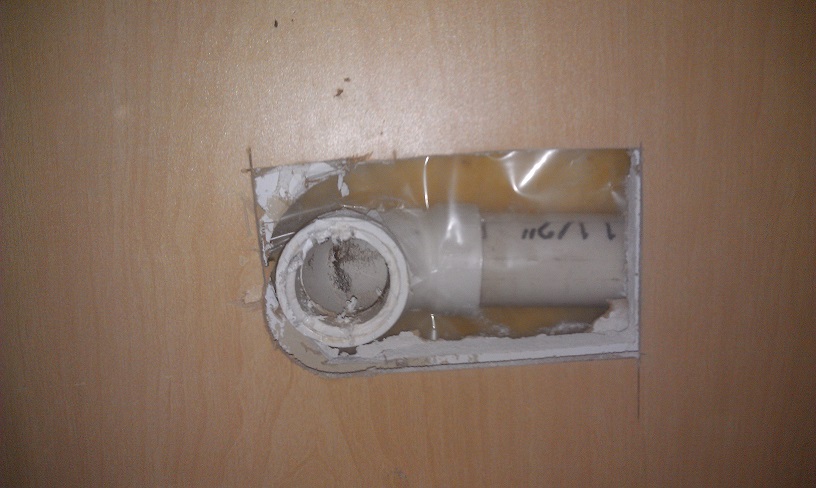
As it turned out the stub was just too short, so there was no way I was going to attach anything to the exposed pipe. My only option was to move back one more fitting, and cut the pipe beyond that. In this situation, this involved opening up the wall a bit. Fortunately I was working under a sink, in a cabinet, so a limited amount of damage was acceptable. I grabbed my trusty Milwaukee multi-tool, and cut a hole in the back of the cabinet and the drywall.

Exposed Pipe

In a lot of instances this fitting will be a tee connecting the sink drain to a drain-waste-vent stack, which may require a bit more damage to the back of the cabinet and wall. In my situation, I was lucky it was a simple elbow.

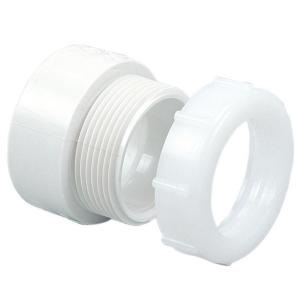
Using my hacksaw blade. I cut off the tee, glued on a new tee, glued on a short stub, and finally glued on a PVC DWV trap adapter.

Fitting

Once that was done, it was a simple matter of installing the remaining bits of pipe.

Complete

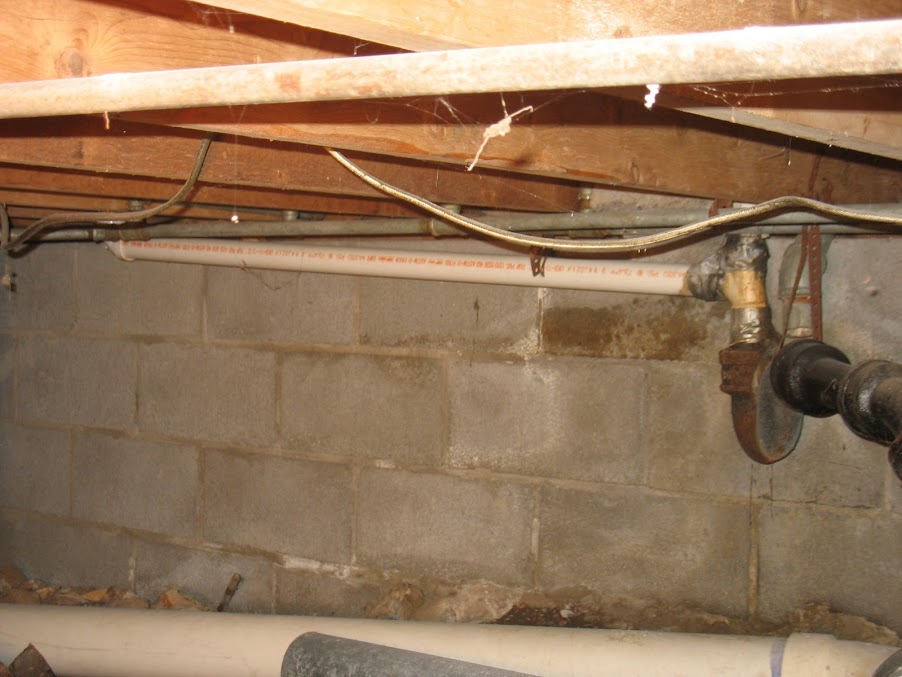
Now my trap is just the right depth, and the waste is flowing as it should.

BeforeAndAfter

profile for Tester101 at Home Improvement, Q&A for contractors and serious DIYers

Filed under Plumbing, Repair

First-Time DIY: Duct Tape ≠ Plumbing

2013-04-02 by . 0 comments

Hello again everyone! When my wife & I bought our first house, we went right to work remodeling it. We started by refinishing the hardwood floors and updating our shutters to add some curb appeal. After the floor was finished, we moved on to begin remodeling the kitchen. While I don’t have all of my kitchen photos ready for you, I wanted to show you what I found while re-plumbing the kitchen.

Let me just explain that the previous owners turned the laundry room into a laundry/bathroom – adding a shower, sink, and toilet. They decided to have the washing machine and sink share the long drain pipe (left) and that the shower would drain straight down. The only thing holding these pipes together was the duct tape – no primer, no glue – just duct tape.

Long pipe (left) is from washing machine & sink

Long pipe (left) is from washing machine & sink

Corner shower drains straight down

Corner shower drains straight down

I replaced this incredibly nasty, 3-Way Sanitary Tee (what an oxymoron in this case) with a Flexible 3-Way Sanitary Tee connector. I used silicone sealant on the inside of the connector before tightening it all and on the seams afterwards.

So the lesson here is always use the correct tools for the job … and duct tape doesn’t always fix everything…


What’s the worst “quick fix” you’ve ever run across? Let us know in the comments!

profile for joshmax on Stack Exchange, a network of free, community-driven Q&A sites

How to Build Sturdy Garage Shelves

2013-03-26 by . 5 comments

I’ve done some finish carpentry in the past, but I’m really more of a framer because I like to just throw things together quickly and make them as strong as possible. With garage shelves, in my opinion, they don’t need to look fancy, but they do need to be sturdy – I’ve seen far too many saggy garage shelves that look like they’re going to come tumbling down at any moment. In fact, I’ve actually had a pet killed by some pre-built garage shelves that collapsed.

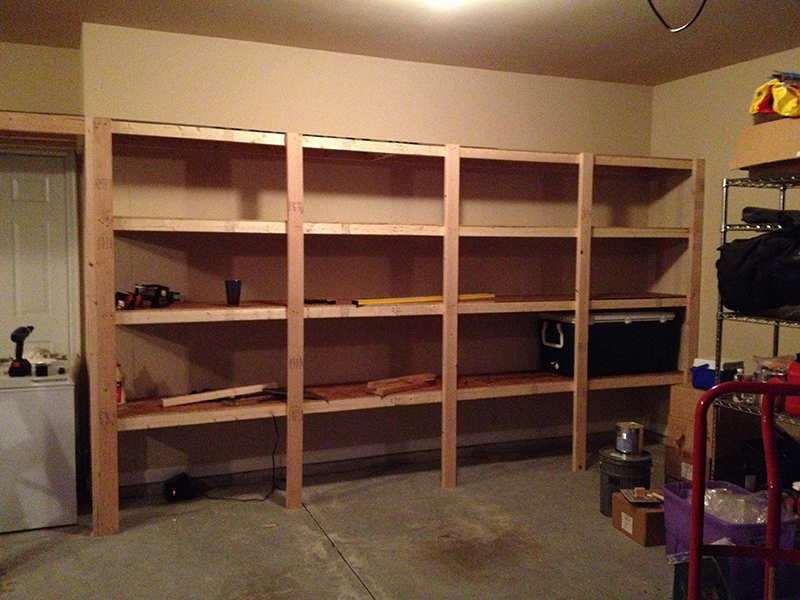
I recently built some new garage shelves in the home we have been living in for a couple years now. I had always planned to build some, but only got around to it a few months ago. I wanted to share my experience to give other DIY-ers an idea of a simple shelving design that is built to last. The pictures in this post are only of one of the walls I built shelves on. The total cost for wood, nails and screws for both walls was just under $200.00. My goal was to build the strongest shelves as possible, without spending too much money. For the amount of sturdy shelf space we now have in our garage, $200.00 was well worth it.

Tools Needed:

  • Hammer and nails (preferably a nail gun if you have one)
  • Screws and a screw gun. I used 3 ½ inch wood screws.
  • Some kind of saw. a chop saw would be best for this, but technically you could use a skill saw, a jigsaw, a table saw, or even a hack saw if you had to.
  • Tape measure
  • Stud finder
  • Long level (at least 4 feet)
  • Pencil
  • Small ladder
  • Chisel (if you have baseboard in your garage)

Prep Work

Measuring

  • Know what you’re going to store on the shelves and their dimensions. Once you know the height of the tallest item you plan on storing on the shelves,
  • Measure the distance between the floor and the ceiling. Divide this distance by the height of the tallest item you will be keeping on your shelves. For example, if you have a cooler that is 20 inches tall, and the distance from your ceiling to your floor is 108 inches tall, you would divide 108 by 24 1/2 (I’ll explain why it needs to be 4 ½ inches taller than your tallest item later). This would equal roughly 4.4, which means that you have enough room for 4 rows of shelving with 21 inches of usable height.

garage-shelves-prep-1 Obviously you don’t have to make all the shelves be the same height, but make sure to have at least one of two rows of shelving tall enough for all of your tallest items. I made our bottom two shelves taller to hold the larger, heavier items (like food storage), and made the upper shelves a little bit shorter to hold the smaller, lighter items. I would also recommend storing all of your DIY chemicals like herbicides, pesticides, or cleaners on the top shelf, so your children cannot reach them (easily…).

Finding and Marking the Studs

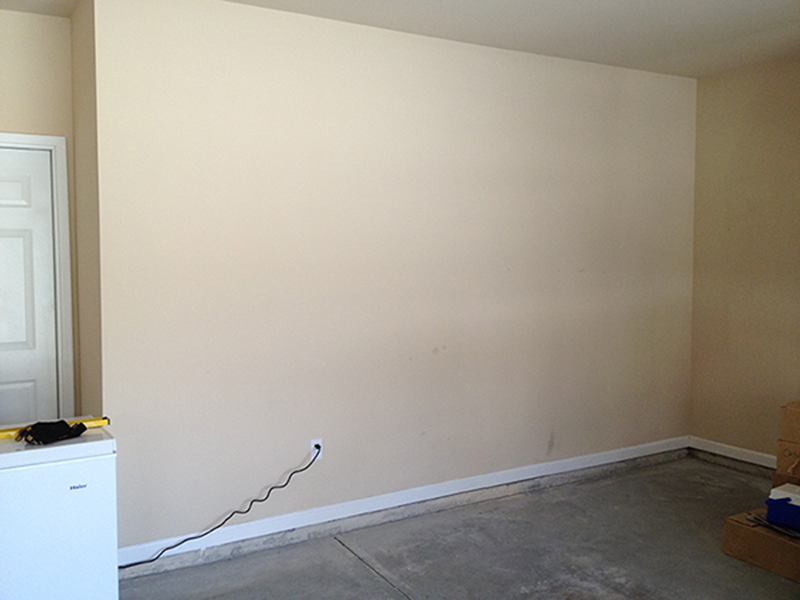
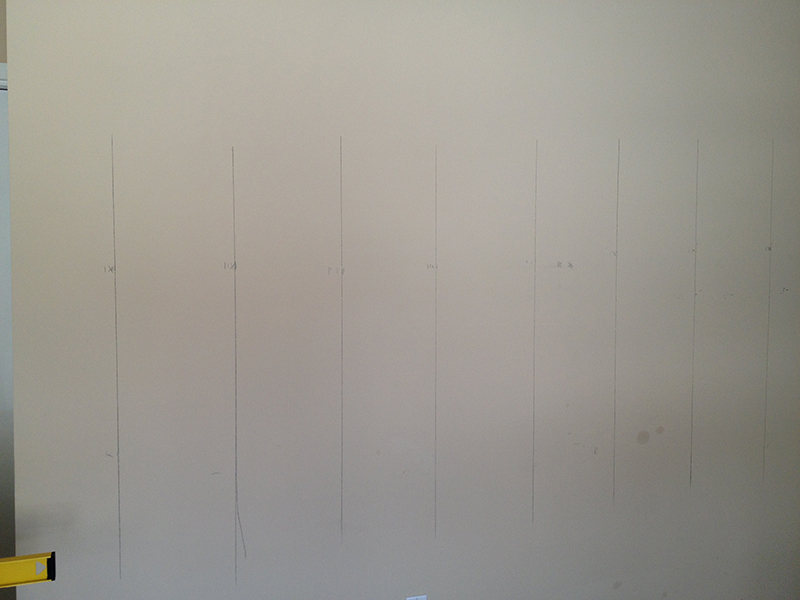
  • You will need a stud finder for this part. What I did was mark all the vertical and horizontal lines that my shelves would follow. Take your stud finder across the wall horizontally (twice), once up higher, and once down lower and mark each stud. Then take a 4 ft (or longer) level and trace a straight vertical line between the upper and lower marks. Use that line to extend the vertical line all the way up the wall. This vertical line will be your guide to help you see where to screw the boards to the wall.
garage-shelves-prep-2
  • Next draw the horizontal lines by measuring from the ground up. If your bottom shelf will have a 21 inch space under it, measure up 24 ½ inches and use your level to draw a horizontal line all the way across the wall. The next horizontal line should be 24 ½ inches above that line (assuming all of your shelves will be the same height). The reason you have to go up 24 1/2 inches to build a 21 inch space is because you have to account for the 1/2 inch plywood on top, and the 3 inch tall  frame board.

Calculating Amount of Wood Needed

  • Given the length of the walls I was building my shelves on, I bought my wood in the 8 foot lengths. I used a combination of 2x4s (for the vertical support posts), and 2x3s (for the main horizontal framework, including the boards tacked to the wall). I also used ½ inch thick plywood for the shelving surface, with the smoother side of the plywood facing up. Lowes will rip cut the 8×4 ft sheets of plywood for you to save you some time. My shelves were about 21 inches deep so I was able to get two, 8 foot long pieces out of each sheet. I found this depth to be good for most tubs and other large items you would store, and plenty of room for storing several smaller items.
  • The wall I built these shelves on was about 14 feet long, so I needed two 8 foot sheets of plywood for each row. I had to cut off the extra two feet with my chop saw.
  • Once you know the length of the wall, it’s fairly straightforward as far as counting up how many 2x3s and sheets of plywood you need. For a 14 foot wall, I used 5 2×4 vertical posts, two on the end and three in the middle, each spaced about 3 ½ feet apart. You can do whatever you want here, but make sure you don’t go too far between the posts so you have enough strength.

Building the Shelves

Once you have all of your lumber, it’s time to start building. This is the fun part and if you’ve already measured and marked everything, the building portion should go fairly quickly (with this design).

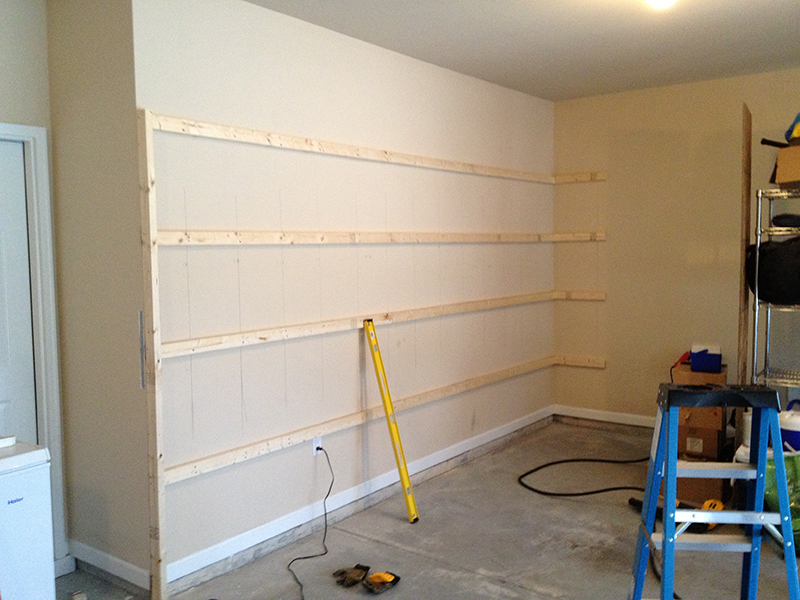
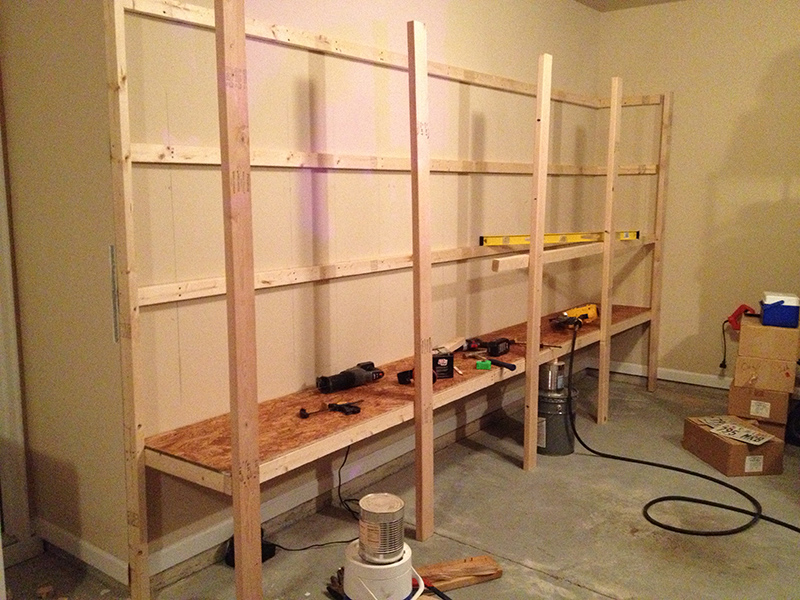
  • The first step is to tack the 2x3s to the wall. Place them over the horizontal lines you drew and put a nail in at each vertical line (where the studs are). I used both screws and nails for this part. Screws offer the horizontal strength, and nails provide the vertical strength.

As you can see in the picture below, I also used the perpendicular wall for increased support. I would recommend this as it provides horizontal strength.

garage-shelves-build-1

  • After screwing and nailing the boards up on to the wall, you can put up the end boards (2x4s). Measure and cut these boards (and all the other vertical support 2x4s) to be ½ inch taller than the highest board against the wall. This is so that when you lay the plywood down on the top shelf it will fit into the frame for additional support.
  • For those with some kind of baseboard in your garage, you will need to take a chisel and notch out a spot for the vertical 2×4 boards that will go on the ends, against the wall. You can also notch out a space on the support beams themselves, instead of the baseboard.
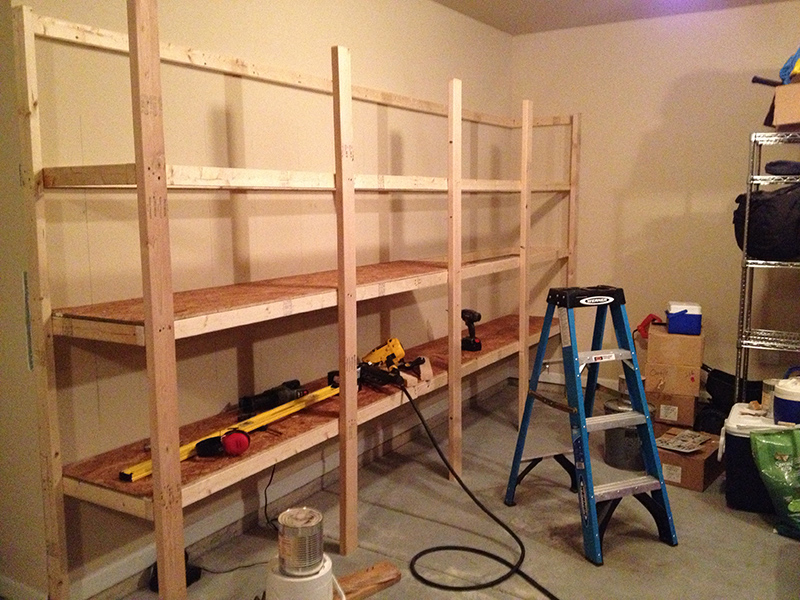
  • The next step is to put up the outer 2×3 boards on each row. Start at the bottom and place something under one end, while you nail the other end to the perpendicular board that is against the wall. Replace whatever you were using to support the other end with the first vertical support 2×4. Nail it into place with only one nail so you can still pivot the board side to side and level it. See image below.

garage-shelves-build-2

  • Continue moving across, putting the next horizontal 2×3 into place and nailing the next vertical 2×4 to it.
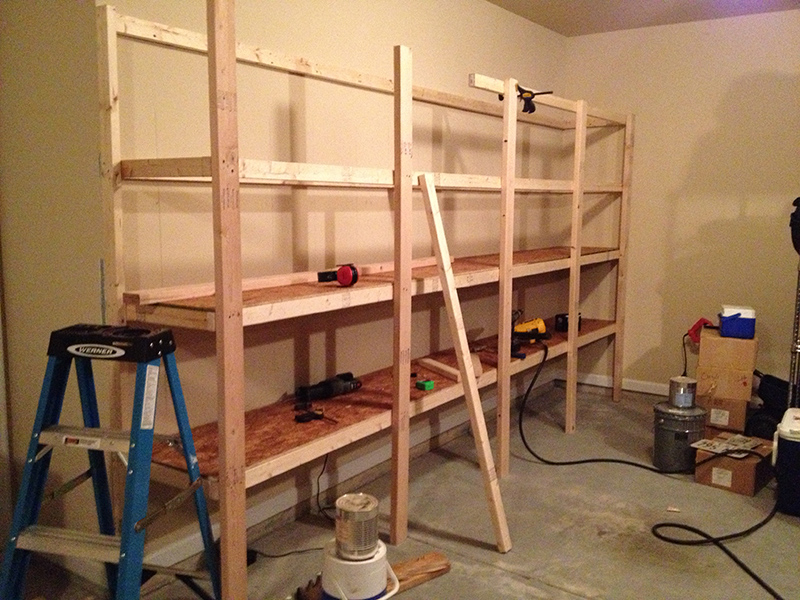
  • Repeat this process with the next row up, but before you nail the vertical 2×4 to the second row, make sure to level it vertically with your long level. After you have leveled the 2×4 and nailed it to the second row, the remaining rows will go quickly. I would still check each row with the level as some boards can be warped and will need to be bent into place.

garage-shelves-build-3

It’s a little difficult to see in these pictures, but I have also tacked in some support boards between the horizontal beams, coming out perpendicular to the main wall.

garage-shelves-build-4

garage-shelves-build-4b

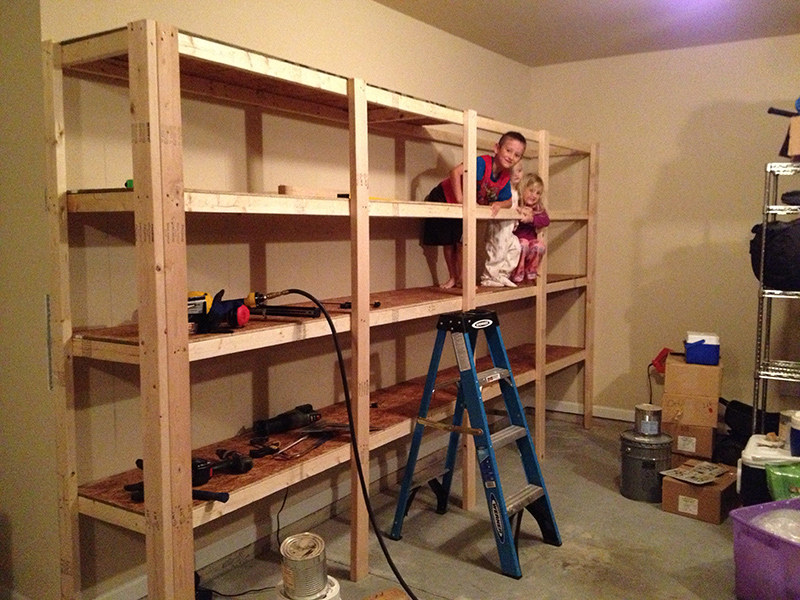
The final step is to lay in the plywood pieces. They should fit right into your frame and once nailed down will offer additional strength coming out of the wall, as well as side to side. I nailed them down roughly every 12 inches.

As you can see in the picture below, your garage shelves should be strong enough to double as a jungle gym for your kids!

garage-shelves-build-5

garage-shelves-build-6

profile for Michael Hasson at Home Improvement, Q&A for contractors and serious DIYers

First Time DIY: Carpet vs Hardwood

2013-03-19 by . 2 comments

When my wife & I decided to buy our first house I had never thought about whether I wanted hardwood floors or not. My wife on the other hand, LOVED them. After we had picked out our house, we were doing a walk through to determine what things needed to be fixed by the sellers  (a sampling): maxwell floors 2

  • Repair the moldy bathroom
  • Find and repair the gas leak
  • Clean the carpet

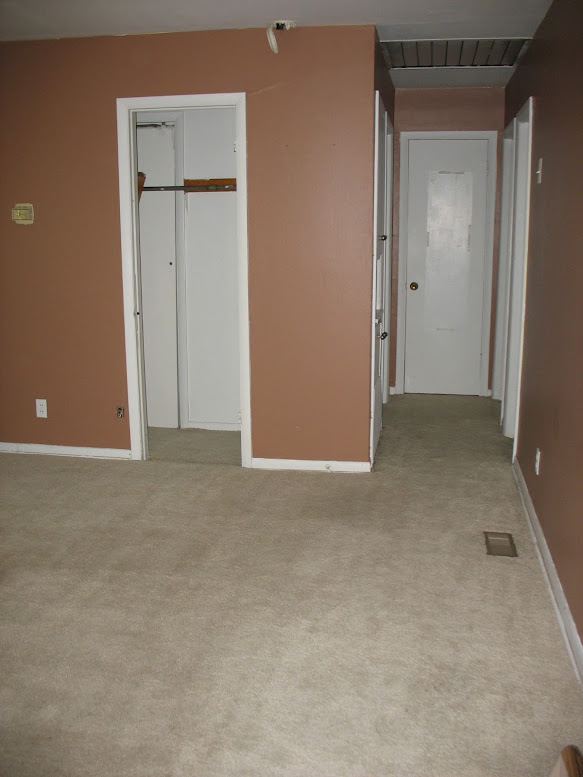
We walked into the now guest bedroom and I saw that there was no molding in the closet and that the carpet was loose. Instead of just marking it down as something for them to fix, I was curious and pulled back the carpet. To our surprise, we found original hardwood floors! My wife flipped.

After pulling back the closet’s carpet completely, we saw that it looked almost as if the floors had been refinished and then someone laid carpet on top of it. What a shame.

Once we found the flooring, the repair list looked more like this:

  • Repair the moldy bathroom
  • Find and repair the gas leak
  • Clean the carpet Whatever you do, do NOT clean the carpet!

But, what the sellers heard was:

  • Don’t worry yourself about the mold in the bathroom, just knock a couple hundred off the price
  • Gas leak? *sniff* What gas le–…. *passes out*
  • Ignore our requests and please clean the carpet and leave it wet Pay ZERO attention to this!

But wait, there’s more!

Filed under Projects
Handling the pressure with expansion tanks

2013-02-19 by . 3 comments

Is an expansion tank required?

Private, older public, and some other water distribution systems may not require an expansion tank to be installed. This is because these systems may be considered “open”, since they lack pressure regulators and/or backflow preventers. Plumbing code changes intended to prevent the contamination of the public water supplies, have made backflow prevention a requirement in most current new builds. While this may be a good change for the water supply, it can be a damaging change to your plumbing system.

IRC2009 P2902.3 Backflow protection. A means of protection against backflow shall be provided in accordance with Sections P2902.3.1 through P2902.3.6. Backflow prevention applications shall conform to Table P2902.3, except as specifically stated in Sections P2902.4 through P2902.5.5.

Before pressure reducing valves and backflow preventers were used, any excess pressure in your system could easily spread back into the water distribution system. This meant any thermal expansion of the water caused by your domestic hot water (DHW) system, could easily be dissipated back through the distribution system. Now that backflow prevention is required, your plumbing system has become a “closed” system, and a new way must be employed to prevent over pressurization.

This is where expansion tanks come in. Expansion tanks are used to absorb any excess pressure created due to thermal expansion, which prevents an over pressurization of the system. In any situation where water in a “closed system” is heated, an expansion tank is required.

IRC 2009 P2903.4 Thermal expansion control. A means for controlling increased pressure caused by thermal expansion shall be installed where required in accordance with Sections P2903.4.1 and P2903.4.2. P2903.4.1 Pressure-reducing valve. For water service system sizes up to and including 2 inches (51 mm), a device for controlling pressure shall be installed where, because of thermal expansion, the pressure on the downstream side of a pressure-reducing valve exceeds the pressure-reducing valve setting.   P2903.4.2 Backflow prevention device or check valve. Where a backflow prevention device, check valve or other device is installed on a water supply system using storage water heating equipment such that thermal expansion causes an increase in pressure, a device for controlling pressure shall be installed.

Symptoms of an over pressurized system

High pressure in a plumbing system can damage any fixture connected to the system, including faucets, taps, toilets, washing machines, dish washers, water heaters, etc. It can also lead to leaks, running toilets, difficult to operate faucets and taps, and even burst pipes. A frequent symptom of an over pressurized system, is a sudden surge of water when a faucet is turned on. The surge will quickly dissipate, and won’t return even if you close and reopen the valve.

If the over pressurization is caused by thermal expansion, you may only notice symptoms occasionally and seemingly randomly. This is because the pressure in the system increases when the water heater is heating, and all fixtures are closed. The pressure diminishes when any fixture is opened, or as the water cools. The problem may only be observed when the system pressure is at its highest, which may only be on rare occasions.

What is an expansion tank?

An expansion tank physically resembles a small propane tank.

Expansion Tank

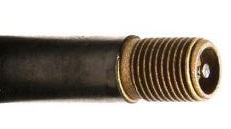
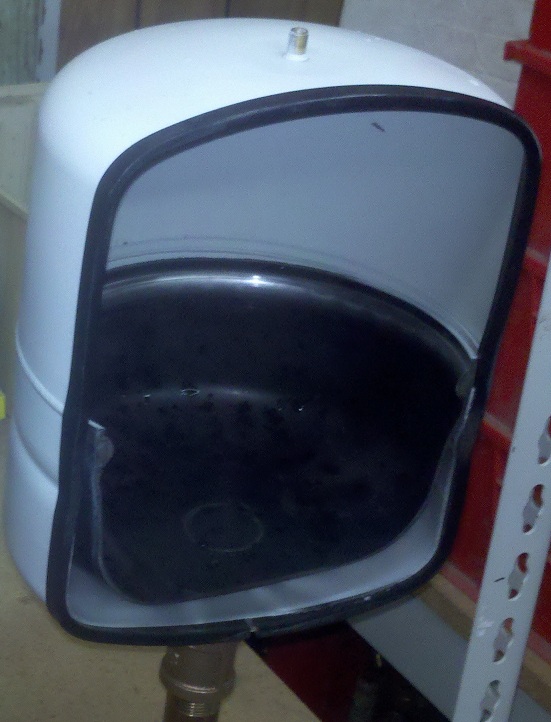
It’s usually installed fairly close to a water heater or boiler, and may be installed in almost any orientation. Internally, there will likely be a flexible (Butyl) diaphragm which divides the tank in two. On the “wet” side, you’ll notice a 3/4” NPTM connection which allows it to be connected to the plumbing system. The “dry” side, often features a Schrader valve which allows the pressure of the tank to be adjusted as needed.

Schrader Vavle

Normally the tank will be completely filled with air, and the diaphragm will be pressing against the water inlet. As the water pressure increases, it compresses the lower pressure air in the tank, and the tank fills with water. When the system water pressure decreases, the air pressure forces the water out of the tank, and back into the pipes.

Inside Expansion Tank

How do I install an expansion tank?

Expansion tanks are installed on the cold water supply of a domestic hot water tank, or boiler. The installation process is fairly easy, usually only requiring a tee fitting to be added to the water line.

Positioning

The first step in installing an expansion tank, is to decide where you want it. We already know that the tank must be installed between the cold water shut off, and the water heater inlet. So we know where it has to connect to the system, but we still have to decide where the tank itself will sit.

Up, Down, Left, or Right?

Most tanks can be installed in any orientation, though there are advantages to some positions. For example. If you install the tank vertically with the air side up, and the tanks bladder ever fails. The tank may continue to function (though at a reduced capacity), until the air escapes from the tank. Whereas, if the tank was installed with the air side down, and the bladder failed. The air would immediately move to the top of the tank, and the tank would fill completely with water.

Support

While most smaller tanks can be supported by the plumbing itself, it can be a good idea to support the tank by other means. Water weighs about 8.34 lbs/gallon, which means even a properly functioning tank can weigh quite a bit. Lets look at an example tank.

  • Tank Capacity: 4.4 gallons.
  • Maximum Accept Capacity: 2.5 gallons
  • Tank Weight: 8 lbs

Maximum Properly Functioning Weight:

2.5 gallons * 8.35 lbs/gal. + 8 lbs = 28.875 lbs.

Maximum Failure Weight:

4.4 gallons * 8.35 lbs/gal. + 8 lbs = 44.74 lbs.

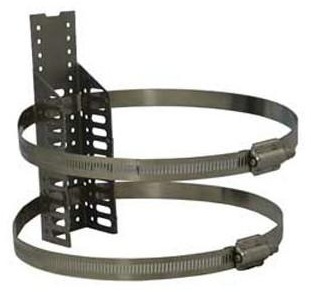
Even when the tank is in working order and fills to maximum capacity, you could end up with almost 29 lbs hanging from your pipes. Because of this, it may be a good idea to attach the tank to a nearby structural member. This can be easily accomplished, using straps and/or brackets designed for this purpose.

Tank Bracket

Installation

Now that we’ve decided where the tank will connect to the plumbing, and where the tank will spend the rest of its life. It’s time to start the actual installation.

Turn off the water

The first thing you’ll have to do is to figure out how to turn off the water heater/boiler, and then actually turn it off. Next you’ll have to locate the cold water supply shutoff valve, and turn the valve to the closed (off) position. Finally, turn on (open) the lowest hot water tap in the house. This will release any built up pressure, and prevent water from spraying out when you cut the pipe in the next step.

Mark and cut the pipe

Use the tee as a guide, and mark the pipe where you’ll be installing the tee. Cut the pipe at your marks, using a pipe cutter.

Pipe Cutter

If you don’t have to cut the pipe, skip this step.

Install the tee

Solder, snap, or twist the tee into place. Then install any nipples or extension pipes required to reach the tanks final resting place. You’ll want to end the extension with a 3/4” NPTF fitting, so the expansion tank can be screwed into place.

At this point you may want to think about adding some extra fittings that will make required maintenance easier. A ball valve and spigot, will make isolating and draining the tank much more convenient. Installing a combination fitting like this Ball drain valve, can make this task much easier and clean looking (Make sure to check your local codes to insure this type of setup is allowed.).

Combination Valve

Check the system pressure

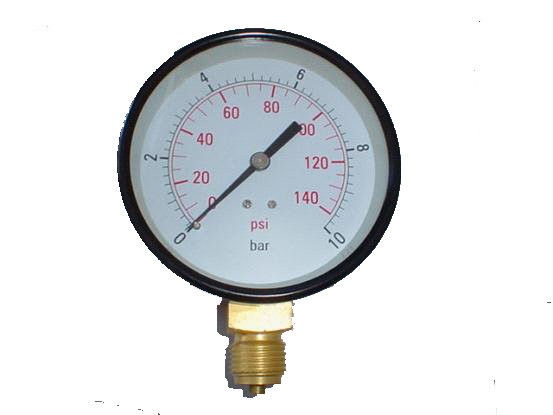
Pressure GaugeAt this point you’ll want to close the faucet you opened, and open the shutoff valves (make sure you cap the extension pipe, or close the valve on the extension, or you’ll have water everywhere). Turn on all the hot water fixtures in the house until water flows normally (no sputtering), to insure the system is filled and at full pressure. Check for, and repair leaks.

Attach a pressure gauge to any part of your plumbing system. Some gauges contain threads for a garden faucet, or you can attach one to the extension where the expansion tank will be installed. Once the gauge is attached, open the valve to get a reading on the gauge. Note the pressure. If the pressure is not within the normal range of 40 – 80 psi, you’ll have to take steps to correct it (which is not covered in this article).


Pre-pressurize the tank

Most expansion tanks come pressurized to 12 – 40 psi, but before you install the tank you have to match the system pressure. Start by removing the protective cover from the air valve on the tank. Use a tire gauge to check the pressure. Use a bicycle pump, or compressor, to fill the tank to match the system pressure you noted earlier.

Mount the tank

Attach the tank to the plumbing, and mount it using your straps and/or brackets. Turn everything on, and check for/repair any leaks. Stand back and revel in your success.

Maintenance

You can quickly verify the tank is working at any time, with a simple tap. When you tap on the air side of the tank, you should hear a hollow sounding dong. If you hear a solid sounding thud, the tank has failed, and is filled with water. In this case, the tank will have to be replaced.

Check the tank pressure

Once a year (see owners manual for schedule) or so, the air pressure in the tank should be checked. To do this, you’ll have to isolate the tank from the water systems pressure (Once again the extra valve and spigot come in handy). As before, you’ll have to shut off, open, close, or disconnect things until there is no pressure on the water side of the tank. Once you’ve accomplished that, use a tire gauge to check the air pressure. Add/remove air as needed. Repressurize the water system, and you’re good for another year.

profile for Tester101 at Home Improvement, Q&A for contractors and serious DIYers

Filed under Plumbing

Tool Review: Werner MT-22 Telescoping MultiLadder

2012-10-02 by . 6 comments

Every homeowner at one point feels the need to either get up on their roof or reach something really high off the ground.  The problem with large ladders is just that – they’re large.  An extension ladder capable of reaching the roof of a typical 2-story house is likely to be 10′ long when stored, which at a minimum may make transporting it back from the store difficult.  Also, it cannot work as a stepladder, as it has to be braced against something solid, typically your house.  The industry has come up with a solution to this issue, and it is known as a telescoping multiladder.

There are several brands of this style of ladder available, and most of them work in a very similar way.  In this article, I’ll be reviewing the Werner MT-22.


There are 4 main ways to use this ladder, and we’ll look at them one at a time.  First, though, we’ll look at the hinges and locks and see how they operate.

Here’s the hinges in the locked position.  The blue plastic knob is sticking out from the ladder, and you can’t see the pins.  In order to move them to the open position, you simply push the blue plastic ends so they are flush with the ladder.  They are pretty solid, but you can move them easily by pushing with the palm of your hand.

Then, you can see the 3 pins pop out of the ladder frame.  You’ll do this on either side, and then the ladder will swing freely until it reaches one of 3 positions – extension ladder, or 180 degrees, stepladder, which I would estimate around 20 or so degrees, and storage, where the legs are right next to one another and the ladder is not particularly stable.  Once it reaches one of those positions, the hinges snap back into place, locking solidly.

The second set of locks are the ones that go into the ladder rungs when they are extended.  They are solid metal pieces that are spring-loaded, and at the end they have a “U” shape.  To unlock them, pull them out and then rotate them away from the ladder.

To lock the rungs, just do the same thing in reverse – pull out the metal U, turn it so the end goes into the rung, and let it slide ino the rung.


The whole system is fairly easy to use, and if there is not any weight on the elements, they slide and go into place quite freely.  If you’re trying to unlock a hinge and it’s under some weight, it might take some wiggling, however.  They can be left half locked (in the outer set of holes) and then when you slide the inner ladder to match up the holes, it’ll spring fully engaged.  There is a tiny bit of a ridge around the inner hole, so it might not catch perfectly every time, but it works most of the time.

Now that we’re familiar with the special parts of this ladder, we’ll go on to review the different ways it can be used.

The first usage method is as a traditional stepladder:

The ladder used this way has a weight rating of 300 pounds per side.  You can lock the rung hinges on any particular rung, so it can be used for a short reach or a long reach.  This is great in a backyard if you want to get up to a high tree branch with pruning shears.  Next is the usage as a stair stepladder:

This method is extremely useful when the thing you are trying to get to is above a staircase.  If you have a larger home, you may have a very large foyer, with some lights in the ceiling above a staircase.  Now you can get to them to work on them, and as a bonus, 2 people can do this – one from either side.

3rd is the primary reason I bought the ladder, the extension ladder:

As you can see, it reaches up to the roof of the second story house, allowing me to clean the gutters.  The top two steps are not meant to be stepped on.  Instead, you’re supposed to hold onto the rungs above you for stability, so I don’t think I could get on top of the roof with this ladder easily, but that is likely to be another project.  This way of using the ladder brings me to its one drawback – the weight.  This ladder is fairly heavy, weighing in at 42 pounds.  The difficulty comes in maneuvering the ladder when it is in extension mode.  I’ve found the best way to use it this way is to extend the top section fully first.  Second, place it against the wall, hold the inner rungs of the bottom section, and undo the hinges.  Lastly, pull it back towards you a bit, just so can pull the inner part up.  I was able to move it a couple of rungs up each time before I leaned it back against the wall and reset my arms to pull it up another 2 rungs.  It gets much easier with practice.  It’s simply very difficult to push it straight up right while keeping the ladder up, and if you extend it fully on the ground, it’s difficult to pull the ladder to an upright position – it is 19 feet long.  This is where one area where a competitor’s ladder, if it is lighter, could be much more useful.  Bonus points for commenting and  describing the unsafe application of the ladder in this picture.

The last method, and the least useful for me, is the scaffold method:

Imagine the pole is a scaffold plank:

This method is used when you are working either on a wide high piece and don’t want to continually move the ladder, or if you are working directly above a hole in the ground (a basement storm cellar outside entrance, for example)  For this method, you simply slide off the inner rungs on both sides, and then lock them together, then insert the plank between the two separate ladders.  I simply don’t have a lot of need yet for this sort of activity, but it’s nice to know that it can be used in that way.

Werner also makes several accessories for the ladder, including a work/tool platform as well as a stand-off/stabilizer that can be used to either allow you to work across a window, or just to give you more stability at the top.

Overall, I am very satisfied with the ladder.  The main problem I have with it, as I noted earlier,  is that it is heavy, but it’s also made out of steel instead of aluminum – you could buy a lighter one, but you’d pay more for it.  It stores easily, and it can be transported in a typical sedan, both of which are things that a “normal” extension ladder is not capable of.  Also, there’s no rope or pulleys involved, which is another plus.  I would give this product a solid 4 out of 5 Captain Constructions, especially if you cannot get an extension ladder home yourself.

4 Captain Constructions

Filed under Tool Review

Installing Laminate/Engineered wood Floating Floors

2012-09-11 by . 6 comments

Recently my wife and I, being sick of Lego all over our living room, decided that it was time to finish our basement. I considered doing it myself, but really didn’t have the time, or the vehicle to haul materials in. We decided to hire a contractor (and got very lucky with a personal recommendation) to provide us with ready-to-paint drywall, and to come back later for trim and drop ceiling.

After installing the drywall and rough-ins, the contractor went off to Bahamas for a week’s pre-arranged vacation (with my deposit I presume), leaving me to install the flooring. I was left with a painted concrete floor (22′ x 15′), and lots of mopping to get the drywall mud and dust off of it.

Before he left, She Who Makes the Design Decisions and I went shopping for the flooring materials.

Our options:

Hardwood

Hardwood Floor Board

Hardwood Flooring is a very attractive and durable solution. Typically, a board is 3/4″ thick, and comes in random lengths from 18″ to 6 or 7′. It’s a tongue and groove board, which needs to be nailed down to the sub-floor at an angle through the tongue. A special nailing tool is used to do this. However, we’re over concrete in this installation, and don’t want to go through the cost and effort of laying a 3/4″ plywood sub-floor or, more properly, dricore. So hardwood is out of the picture.

Engineered Wood

Engineered wood

There are two basic types of engineered wood. Nail/Glue down, which is simply three plies of wood, staggered to make a tongue and groove shape like hardwood, and a final finish layer of actual hardwood. This is installed like hardwood, or it can be glued along the tongues to make a floating floor.

Alternatively, there is click-lock flooring, (pictured above) which requires no glue or nails. Typically, the base layers will be plywood or HDF (High Density Fibreboard – Think sawdust and glue pressed into a board), with a 3/16 layer of hardwood on top. This stuff is relatively easy to install, and slightly cheaper than hardwood. This is the product we were originally looking at. Engineered wood typically comes in random lengths.

Laminate

Laminate Flooring

Laminate is essentially the same as Engineered, except instead of glued hardwood top layer, there is a printed surface covered in melamine. This means that a good quality laminate can be more durable than any natural wood product. Laminates that have a melamine bottom layer are also less susceptible to moisture, which makes them perfect for a basement. Furthermore, they tend to be significantly cheaper than both engineered wood and hardwood — Which is a major consideration in a basement, where there is the remote, but real, possibility of flooding resulting in a complete replacement of the flooring.

diy.stackexchange.com user Shirlock Homes makes a case against laminate here. There is a lot of merit to what he says. Laminate cannot be re-finished, and cheap laminate tends to wear our quickly, leaving you with bare HDF. Notwithstanding his expert advice, I do believe it is the correct, economical choice for a basement. Just make sure the Skil-Saw blade has stopped spinning before you put it down.

Laminates come rated AC-1 to AC-5, with 5 being the highest quality.

Rating Usage
AC-1 Bedrooms
AC-2 Living/Dining Rooms, Kid’s Rooms
AC-3 Hallway, Living Room, Office (rolling chairs!)
AC-4 Office, Cafe, low-traffic retail
AC-5 High traffic public areas – Retail, Banks, large offices


The product we ended up purchasing was AMAZONE Canadian Maple, by KRONOTEX. This is an AC-4 rated product, which means it should be more than sufficient for our basement. This product comes in fixed lengths.

Preparation

Now that we’ve selected our product, and loaded it into the job site it’s time get the prep work done.

  1. Ensure the floor is level, and flat. If it isn’t, you have to decide whether you want to grind down any lumps, level the floor with Self Leveling Compound, or live with some imperfection. Our floor had some variation, and we probably should have leveled it, but the cost was prohibitive. We decided to accept the imperfection.
  2. Remove baseboards, and undercut door trim. (Not required in this installation, as it hadn’t been installed).
  3. Clean the floor – This is critical. You don’t want any lumps of mud or any organic material on the concrete – this is food for mold!
  4. Stack your material on the wall you are going to finish LAST. Leave it there for a few days to acclimatize to the moisture level of your room.
  5. Lay the underlay. Some say that the underlay should run perpendicular to the flooring. However, this means that you have to do all the underlay in one go, and keep it clean while you work (an impossible task!). Since it comes in 3′ widths, I prefer to run it the length of the room, lay the flooring on top, and lay the next section when I get near the edge.

The Installation

Tools

  1. Mitre Saw -for cutting boards to length
  2. Table Saw – for ripping your final boards to the appropriate width.
  3. 4 x diy.stackexchange.com Carpenter’s Pencils.  You’ll need one at each saw, one behind your ear, and one left on the floor near the end of the run.  Beware of inferior pencils. Only the official diy pencil will work.
  4. 2 x Measuring tape – one in the work area, and one by the table saw.
  5. Undercut saw – for cutting under door trim (if necessary)
  6. Broom and Dustpan
  7. Shop Vac
  8. Jigsaw

Since the end of each run will require a cut, I prefer to chop my boards in the work space.  This necessitates lots of cleaning and vacuuming, but saves many trips up and down the stairs.  The table saw can be set up in any convenient location out of the work area, such as a nearby garage.

STOP! There’s one last bit of thinking!

One thing we need to avoid is a skinny little space left over after our final run. Since my boards were nominally 3 inches wide, I need to know how much space will be left over for my final course. Ideally, I’d love it if the final board just clicked into place leaving me a 1/4 inch of space to be covered by the skirting. THIS WILL NOT HAPPEN! The reality is that you need to rip (length cut) the final course to make it fit. We could just blindly plunge ahead and deal with that issue at the end. But, we could end up with a 3/4″ space, which will just look awful. We need to estimate this gap before we begin.

  1. Measure the room width as accurately as possible. You want to find a maximum and minimum width, to the 16th of an inch.  See http://diy.blogoverflow.com/2011/12/secrets-of-the-tape-measure/, BMitch’s excellent post on measuring.  Subtract 1/2 an inch (you need 1/4 inch gap on either side)(I ended up with 15 ft, 2 12/16 inches)
  2. Snap 3 or 4 boards together, and measure the width to the nearest 16th of an inch. Divide by 3 (or 4) to get the board width (3 1/16).
  3. Convert everything to 16ths of an inch. Room =(15 x12 + 2) x 16 + 12 = 2924 16ths.  Board = 3×16  + 1 = 49 16ths.
  4. Divide the Room width by the board width 2924/49 = 59.67346939 (keep all significant figures)
  5. Subtract the integer part, and multiply by the board width (.67346939 x 49 = 33 16ths)  This is more than half a board, so I’m good.
  6. In the event that you end up with less than a half board (lets say 15 16ths)  the solution is to rip 1 inch off the tongue side of the starting boards, so that you’ll end up with an approximately 2 inch board at either side of the job.


Before we get started, lets define some terminology. Unlike hardwood, you lead with the groove, and snap the tongue of the next board into it. This picture explains what I mean:

Let’s go!

Take a piece of flooring (ripped if necessary), and lay it in a corner, over your underlay, parallel to the longest wall. Remember to leave a 1/4 gap around the walls. The trailing edge, and the trailing end go up against the walls. It will move, so don’t worry.

Continue down the wall, butting the next board to the one before, and the trailing edge should click into the leading edge of the previous board. This is going to move, so again don’t worry.

When you get to the end, your piece of wood will be too long. (If you have random lengths, pick one that is significantly longer), it’s time to make our first chop.

Interlude: Cutting Boards to Length

We need to cut a board to fit the remaining space AND leave a quarter inch gap. We could mess around with measuring and calculating, but I’ve figured out a better way.


  1. Lay the board upside down trailing edge (the edge you want to keep!) butted tight to the wall over the last board you installed.:
  2. Using your diy.stackexchange.com carpenter’s pencil (as seen in the image above!), mark the tongue exactly even with the previous board. (This gives us the full length – we still need to remove 1/4 inch)
  3. Lay the mark on the board right on the edge of the slot of your mitre saw and cut.  This should be close enough to 1/4 short of what we marked.  As long as the skirting/quarter round covers the gap, we’re good.)


Carrying on…

Slip the piece marked KEEP into the end of the row.  The piece marked waste, if really short can be thrown out. But! hopefully it’s pretty long, and we can use it to start the next row. If you have random lengths,  pick your end piece to leave enough for the next row.

The next row is probably the most difficult.  You need to slip the  trailing edge of the current row into the leading edge of the previous while making sure the butt joins of the first row are perfectly aligned.  If the board doesn’t slip in easily and click into place, your butt joins are misaligned OR there’s crud in the groove.  I find that the  corner of the trailing edge and end grooves often gets a bit munged up.  It’s easy enough to remove any imperfections with your fingers, or a utility knife.

Carry on with the second row, making an end cut when necessary.

Now that everything is locked together, the third row is much easier.  Notice however, that the floor is still moving.  Don’t worry about it until you have 4 or 5 rows down.  Then the floor should be heavy enough to hold itself in place.  Just remember to check the 1/4 inch gap against the starting wall every once and a while, and slide the laid flooring around to correct it. Once you’ve got halfway, move your material from the finishing wall to a convenient location on the completed portion of the floor.  This will help hold it down, and get the material out of your way.

Hopefully, you can continue on until the last course, laying a new row of underlay as required,  rip a few boards at the end, and slip out for a beer. (Not Bloody Likely!)  What’s likely to happen is you run into something like this:

or into a closet door, a run-out to a stairwell or some other obstacle. You’re going to have to cut.

Dealing with obstructions

You have two choices here. You can  measure the distance,  and cut the first board of the row so that your seam ends up in the middle of the obstruction, and make a join like this:

or you can cut out the middle of the board with the jigsaw.  The trick with the second option is getting the width of the cut.  Here’s how you do it:

If you do it right, your end result should look like:

Note, that this measuring technique is extremely useful for measuring the rips for your final row.  Remember your 1/4 inch gap!

Another obstruction you might run into is a closet.  This takes a bit of doing, but it isn’t that hard.

The problem here is that I was working left to right, and had to then work right to left in the closet, which is difficult as the material is designed to be worked in one direction.  However, it is possible to clip in a piece from the rear.

When I got to the opening of the door, I cut the board out  in the middle as above, and ran it to the back of the closet.  I then removed this board, and put it aside for later.

I laid the floor in the closet just as if I was starting fresh, making the first board a whole board. until I got past the opening.  I then removed the FIRST board, and laid the piece that I had cut out, connecting it to my closet boards.  Now I’ve got something I can measure!   Rip the first piece, and try to slip it in from the back. Alternatively, I could have undone the last few feet of work in the closet, and relaid it fresh, starting with the ripped piece.

The Last Row

If you’re still with me, you can probably figure it out for your self.  We’ve got a gap at the end, which is too narrow for a course of boards.  In an ideal world, we should be able to measure, set up our saw and rip 4 or five boards at once. This might work for you, if you can verify that the gap is a consistent width the entire length.  It probably isn’t.  Remember that nothing in your house is parallel or perpendicular to anything else in your house.  There is error in everything constructed.  You’ve got to measure each board by itself.  Use the stacking technique in the dealing with obstructions section to figure out the widths.

Once you’ve ripped and installed the boards, you can reinstall the skirting boards and quarter round, or decide to leave that for another day.

Hopefully your final product will look as good as this:


Total Time: 7 hours for 330 sq. ft.

Summary:

  1. Do your prep work. In particular, measure accurately to avoid a 1 inch rip at the end.
  2. Keep your work area clean. Dust and bits of cardboard packaging in the grooves make the job tough.
  3. Slow and steady wins the race.  You can’t rush this.
  4. Deal with obstructions properly.  Measure twice cut once.
  5. This really is a one person job.  Helpers get in the way.  Although an extra hand on the broom or clearing packaging is appreciated if someone pops in for a few minutes.
  6. This job is hell on the knees and back.  You will need a liberal application of “muscle relaxants” after completion.  Don’t make any plans for the evening.
  7. Only @aarthi approved diy.stackexchange.com Carpenters Pencils will do.  To get some, write a blog post on a project, or a tool review, and @aarthi will send you some!  Talk to @tester101 about your blog account.


profile for Chris Cudmore at Home Improvement, Q&A for contractors and serious DIYers

Filed under Projects
Building a brick pizza oven into an existing space.

2012-08-07 by . 4 comments

When we purchased our house about 3 years ago, a nice feature was a lovely brick grill area on the back patio. Inside of it was a natural gas grill insert. Unannounced to us, this grill was severely weathered; rusted through and generally not very appealing to look at.

I disconnected the natural gas line, scraped the grill and thought for a few years on what to do with the space. Do I tear down the brick and turn this covered patio into a room? Turn the brick enclosure into an oven? We both had our own ideas – the wife said do nothing; I wanted to gut it and make it an office.

We have increasingly been making our own pizzas and breads and the gas oven in the house just isn’t cutting it anymore. We use a pizza stone and already broke one because we tried cooking at too high of a temperature.

“Let’s build a pizza oven!”, I proclaimed. You can make bread in there as well and maybe we’ll cook some vegetables to go on the pizza.

3 days and $600 (ish) later, I’m finished, and this is my story.

After removing the grill, I had this big, gaping 36inch x 36inch hole. First, I built a frame from 2x4s, added a center support, and covered it with plywood. This would fill in the hole without spending a ton of money on cinder block or other brick material.

I cut and screwed in a 2×6 onto the front of the brick enclosure to act as a mold for the concrete base. To prevent cracking, I placed 8 24inch 1/2 inch rebar rods into the middle of the 3-4inch thick concrete base.

I mixed the concrete per the directions and let it set up and dry. While it was drying, we took a trip to the brick yard. We initially purchased 120 fire bricks, or, refractory bricks, 2 bags of Heat Stop 50 mortar, a trowel and a 2 foot level. I also needed a 4 inch masonry chisel and later I would purchase two 4  1/2 inch masonry cutoff wheels for my grinder (more on this later).

After 2 days of the concrete curing, I was ready to lay some brick. I watched numerous youtube videos on different methods and read websites from others that have built brick ovens.

One website said to use a 1/4 inch trowel and lay a base of mortar for the floor fire bricks to lay on. As I had no experience in doing this, I tried that, only to find out the mortar was drying too fast for me to work with it and my concrete base was not as level as I had liked it to be. I began to apply the mortar only to the bricks I was laying (as I would with tile) and level everything as I moved along. This worked well and soon I was done with the base.

Next were the walls. There are primarily 2 types of ovens you can build. The first is a Pompeii oven. This is a traditional dome oven, sometimes with a flu, sometimes without. I shied away from this type only in that it would require many cuts to build the dome and I wasn’t that experienced.

The 2nd common type is an arch style- this is just a simple arch from left to right with a straight brick wall in the back. This is easier to build as it requires less cuts, can be done in stages and is generally easier to construct. This is the option I went with.

I knew I had a limited amount of vertical space to work with as I was building this oven in an already enclosed space. I needed to consider how high I would make the walls, If I’d be able to get my hand inside to lay the top bricks of the arch and how tall the arch would be.

I decided to go with 4 rows of bricks for the oven side walls. This would leave me with roughly 16-18 inches for the oven arch.

**** You want to keep the oven as small as possible while still being functional. The bigger the oven is, the more energy required to heat and keep it heated.

On the front of the oven, I left the top brick out on each side as I knew I would do a 2nd arch for the opening of the oven. Again, the bigger the opening is, the more heat can escape. I had a pizza peel already in my kitchen, so I took a measurement of it. It measured 14 inches across the width. Using just 1 brick on each side of the front left me with an 18 inch opening. Perfect! Plenty of room to get the peel in and out with the pizza on it.

With the walls built, I needed to build a form to support the arch as it dried. This form can be made out of any rigid material and is just a temporary support until the arch dries. Having run out of plywood (and not particularly enjoying working with a circular saw) I opted to use scrap drywall. I was remodeling a bedroom this week anyway and had scrap left over.

I took the interior measurement between the side walls, and cut a piece of drywall to width.

I used 11 bricks on the floor of the oven side to side, so I took 13 bricks and began laying them on the drywall in an arch pattern. I used a small piece of drywall to space the back of the bricks for the mortar gap and worked to make both sides of the arch consistent.

Once I was happy with the arch shape and having researched different arch types online, I traced the outline of the bricks onto the drywall and cut it out. I left a 1 inch gap at the bottom to fit in between the walls to give it left to right rigidity. This 1 inch gap, sitting on top of 4 stacked bricks made up the mortar gap in the wall and put the arch where it needed to begin at the top of the wall.

I traced this initial arch onto 5 other pieces of drywall. I then cut 4 inch blocks from 2x4s as spacers and screwed 2 arch supports on either side. This would give the templates a means of standing up right. I decided on 4 inches for the 2×4 because a fire brick is 9 inches long. 4 inches would allow a 2 piece template to span 2 bricks lengthwise (giving the dome more stability as it built it).

I placed the arch templates into the oven, propped up on 2 stacks of 4 bricks and spaced the arch supported front to back to cover the depth of the arch.

Once I was happy with placement, I began to dry fit some bricks for the arch to make sure everything would work out the next day. I knew the first brick of the arch would need to lean back against something. I decided to place a brick on its short end on top of the wall. This would leave me with half the space of a brick left; leaning the first arch brick against it put the brick at a 45 degree angle. Perfect!

I would fill in the void of the 45 degree angle with mortar. Some people that had built brick ovens online put 1 brick right after the other. This is not the correct way to do it. You want to stagger your joints on the arch just like you would on the walls. This of course, takes more time as you need to cut a few bricks in half (re: masonry cut off wheel) but ultimately leads to a stronger arch.

So, the arch is done. I left the front 2 bricks of the center of the arch out to provide ventilation into the existing chimney stack. 2 keystone bricks were cut to match the angle of the arch and maintain the structural integrity of the arch. I was left with an opening of roughly 1 half brick which will eventually have a steel door installed into it to allow the oven to retain more heat.

The main arch was allowed to dry over night and I began work on the front fascia. Another form was made from drywall; this time using 7 half bricks cut with the grinder. The rest of the front fascia was built as a normal wall would be. When I could I tried cutting bricks to fit gaps around the arch. 2 gaps exist on either side of the arch which were filled in with mortar. I’m not sure a pro could cut bricks to fit those gaps but I think it gives the oven a bit of character.

The very top, last row was a tight fit. To small for a full brick by all means; to small for a split brick as a lintel supports the rest of the original structure. We had originally thought to take scrap broken pieces and do a mosaic but the wife came up with the idea to cut 1/2 inch strips from the splits and mortar them in place. This was a fantastic idea and was how we finished the build.

Snags and things to keep in mind along the way:

  • Had this not been built into a pre-existing space, I believe it would have been much easier to complete. I could have worked on any part of it from any direction. As it was, I could only work on it from the front, having to contort my body to reach some spots of the arches along the way.
  • I bought a brand new 4 in brick chisel for $10 at Home Depot. Great tool, but what saved the day in the end was the $3 masonry cut off wheel for the grinder. Mark a line on the brick, cut into the brick with the grinder as deep as I could. Put the chisel in the cut and tap twice with a hammer. Perfect, clean cut. This was done on all of the front arch pieces for a nice clean cut.
  • Don’t even think of trying to cut a brick length wise; go buy some splits from the brick yard and use them. I shattered 3 bricks thinking I could slice down the middle with the chisel.
  • At 8am when I started, it was about 70 degrees outside and my mortar just slightly loose. At 10am it was 82 degree’s out and my mortar was getting firm and I had to add water. No big deal, but realize the mortar is not on your side. It will wait for no one and will dry without notification. Keep your tools clean; clean tools work better and last longer.
  • Take your brick count and add .5 to it. Double your mortar amount also. The Heat Stop 50 bag said I should be able to lay 100 bricks with one 50lb bag. Yeah, not a chance.
  • If you’re trying to split a brick with a hammer and chisel, make sure the brick is on firm, flat ground. Once or twice I split the brick with a small pebble under it and the brick split in the wrong place. They can be that sensitive.
  • Mix only the mortar you need. Do not mix the entire 50lb bag. I made about 4 batches per bag. I chose to mix the batches by hand with a gardening trowel instead of a drill and paddle mixer so I could control the water amount and consistency better. On the walls I wanted the mortar a little looser so I could get my joints as close to 1/16th as possible like the instructions said. On the arches, I wanted it a little firmer so it would hold the brick better.
  • Double check your forms. I placed 1 backwards and my arch was a touch off. I had to shim those bricks with wooden shims. No big deal and I had the shims on hand, but a pain in the butt that could have been avoided.
  • Dry fit everything that you can. It’ll give you a nice visual on how things will fit. In my case where my space was confined, it let me see beforehand if something had to be cut, how thick my mortar lines had to be to account for any unlevelness, etc…
  • Put the level on everything. 1 brick being off by 1/16th isn’t a big deal. 10 of them is. I used a 1 foot level and a 2 foot level side by side on all bricks where I could.
  • Take your time and do not rush.
  • A brick is not terribly heavy. Picking up bricks one at a time, holding it with one hand while applying mortar and then trying to put the brick into a confined space and a brick weights a ton. Take your time, drink lots of water (or Gatorade and coffee) if its hot out and you’ll be fine.
  • Wear gloves if you value your skin.
  • Keep your eyes on the chisel. I hit my hand thumb once (fortunately) with the hammer. At the force you need to hit the chisel with the hammer to crack a brick, It’s not a pleasant experience.

All in all, 150 full bricks were used. 5 split bricks, 3.5 bags of mortar and 5 bags of concrete were used. I plan to do a test burn the day before the 4th of July and if everything goes well and nothing comes crashing down on me, to make some pizza on the 4th of July. Articles I have read online say the oven should get up to 700-900 degrees and can spit out a thin crust / New York style pizza in just under 2 minutes. We’ll just have to capture this on video.


profile for Mario at Home Improvement, Q&A for contractors and serious DIYers

Filed under Projects

Hanging Shelves

2012-07-31 by . 5 comments
This is a continuation of my previous blog post.
This blog posting was originally written in 2008 for a friend of mine who was unable to perform simple repair tasks around her house. The original purpose was to assist her in hanging shelves on her wall. It is intended for those people who know that the flat end of the nail is the end you hit with the shoe, and that butter knives make acceptable screwdrivers.

L- Bracket Shelves

So, let’s look at the simplest type of shelf to put up: Basically, we’re talking about a plank of wood, and two L-brackets. It’s not the prettiest type of shelf, but it is cheap and functional. I actually don’t recommend this type of shelving for all but the most utilitarian installations. BUT, this installation will demonstrate the essential properties of shelviness — The shelf is level, and it is strong enough for most small loads. The techniques used here are also applicable to hanging curtain rods and small bathroom shelves. My general principle is that you can’t possibly measure and pencil out the installation accurately. (See Golden and Silver rules in my previous article.) So we’re going to do this in a way that doesn’t require that.

Materials:

1 shelf 2 brackets 1 pencil 1 carpenter’s square (It’s called a square, but it might be triangular in shape) 8-10 screws – Often these will come with the brackets. You’re probably best off to get some longer wood screws for the wall mounting. Keep in mind that your drywall can be up to 3/4 of an inch thick, and we’ll want at least an inch in the wood. I’d get 2 inch wood screws with a countersunk head. 1 drill drill bits 1 level 1 helper – these can usually be found by offering a beer.

Step 1: Hold the shelf up to the wall where you want it to go. Take a pencil and mark the height about 6 inches in from one end. This is just a rough guide for now. You don’t need to mark the entire length.

Step 2: Find the studs. This can be tricky, but if you’re going to use it for books, then you need to find a stud. Sometimesyou can find them by tapping lightly with a small hammer and listening for a spot where the echo turns into a thud (a doctor’s knee tapper would be ideal). This might work if you have drywall and wood studs, but plaster and lathe seems to make the same sound no matter where you tap it. Borrow an electronic stud finder from a friend. I you can’t get a stud finder, then we have to resort to destructive testing. Find a long skinny nail, such as a two inch finishing nail. Bang it in where you think there might be a stud. Move over an inch and a half an try again. Repeat until you know you’ve hit wood. The problem with this technique is that you will be left with a plaster repair and paint touch up when done, but it is reliable.

Once you’ve found one stud, the other is easy. Studs are usually placed every 16 inches. Just measure over and tap again. Mark the studs with vertical pencil marks (lightly – You’ll want to wash it off later). I like a couple of ticks at the edge, and a longer line down the middle. .|. For shelves, it is imperative that you find a stud. Drywall plugs won’t support the weight of books.

Step 3: Place the board back up, center it on the studs, so there’s an even overhang on each end and mark on the board, ONE side where the stud line meets the board (ideally about 6 inches in from the end). Take the board down, and on the underside using a square (which is usually triangle shaped) mark the perpendicular right across the board.

Step 4: Balance the board on its back on a good solid flat surface so that the edge that will contact the wall is against the floor. Do your best to keep it straight up and down. Put one of the brackets against the board and the floor and press so the flex is taken out of the bracket, and the screw holes are directly over the line. Have your helper mark the screw holes on the board. (That 2 inch finishing nail works great! Stick it in the center of the hole and tap lightly with a hammer).

Step 5: Drill out the screw holes. The diameter of the drill bit should be slightly smaller than the inner diameter of the screw (The solid part inside the threads.) Attach the bracket to the board. NOTE: Your drill will usually tend to “Walk” away from the marked point when you start it up — particularly on hard materials. This is less than ideal. You can take a nail, and bang a dimple over the pencil mark to stop this. The small hole will grab the point of the bit and stop it from walking.

Step 6: Mount the shelf, lining it up with your previous marks, and mark only the upper screw hole where it meets the wall and stud. Drill. You can use a small bit, as you’re going into a 2×4 here. Screw in the upper hole, and lightly put a screw in. You’ll be taking it out in a minute.

At this stage, you’ve got one bracket, tightly secured to the board, and loosely secured to the wall.

Step 7: Level the shelf. This is fairly easy, as you have one fixed end to pivot around. Just move the other end up and down until the level bubble is centered. Mark the stud line on the board and mark the underside of the shelf against the wall (As per Step 3). Take the shelf down, and repeat 3-7 for the other bracket, and finally drive home the actual screws that will hold it up.

Hanging Shelves with Vertical Rails and Brackets

Shelves with vertical rails are a relatively cheap solution. They consist of two or three vertical rails that are screwed directly to the wall. Brackets clip into the rails, and the shelves lay across the brackets.

The IKEA version is functional, but rather pricey for what it is. You can buy the parts at any hardware store and build your own to fit your space. If you go this route, Laminated MDF is a good choice for the actual shelves as it is pretty stiff. However, it can be unattractive. Another choice is to buy some 12 inch pine boards at your local lumber yard. They will cut it to length for you there, so have the measurements ready. You can then stain or paint it yourself.

Canadian Tire has a two shelf 24″ kit for 19.99, (White, melamine laminated MDF) so this would be a cheap starter. You could replace the shelves later.

These instructions are written assuming the DIY route. If you buy a package, then some of the cutting and measuring can be eliminated.

Design and materials.

Typically, 3/4″ lumber storing books can span 36″ without significant sagging (according to the wisdom of the internet). However, studs are 16″ apart, so 32″ is a better choice. A 4 foot shelf can be problematic. The only mounting solution is three rails at 16″ spacing or 2 at 32″, leaving 8 inches of overhang at either end. The danger is that a partially loaded shelf might flip up like a teeter totter if there is too much overhang. I’d feel better with 3.5 foot shelf, which could be mounted on two rails at 32″ spacing and 4.5″ of overhang.

Leave about 6 inches of excess rail above the top shelf and below the bottom. This will help distribute the load nicely over the wall.

You might wish to take a measuring tape and a piece of chalk and actually draw your shelving on the wall before you head out to the store. It really helps to visualize the solution. (hint – find the studs now, as they are where the rails go.)

Materials: 2 or 3 rails. Buy them pre-cut. They typically come in 24, 30 and 60 inch lengths. 2 or 3 brackets for each shelf. Shelves. Screws. Drill, Bits. Driver. Helper. Level. Plumb Bob and chalk line (optional) Chairs or step ladder.

Getting to work:

Step 1: Preliminary Reconnaissance Figure out where you want the shelves to go, and hold up the upper one to the wall. Mark the end points so you know your boundaries. Now you need to find the studs. I’ve discussed that in the L-Bracket shelf instructions, so I’ll leave you to it. However, if you are hanging a 24 inch shelf on 16 inch studs, that leaves 4 inches of overhang at either side. You might have to move your ideal location over a bit so that the shelf is centered on the studs. Once you’ve found the studs, hang a chalk line and mark it. Alternatively, mark it with pencil in several locations and use the edge of a shelf, or even the rail itself to mark the studs.

Step 2: Like before, we’re going to do one side first, and then match the other to it. Figure out where the top of the rail needs to go. Mark the top screw hole, and drill. Again, the drill bit should be smaller than the screw. Lightly screw the rail to the wall using the top hole only. Let the rail hang loosely.  Hopefully the rail will hang exactly over the line you drew earlier. If not, you have to decide now which vertical you want (i.e. Your studs aren’t vertical, or the gravity works differently in your house) . The likelyhood is that neither is correct. Check with the level if you need to. Once you are satisfied, mark the remaining screw holes. Tip: You probably won’t be able to get a pencil to touch the wall through the rail. Use a skinny nail, and give it a light tap with a hammer to mark the wall. Draw a circle around the marks so you can find them.

Step 3: Mount the first rail. Take out the single top screw, and take the rail down. Now drill out the holes you just marked. Put the rail back up, and screw the screws in until they are just tight. It’s best to do the top and bottom first, ensuring everything is lined up straight. Then fill in the middle ones.

Step 4: Mark the other rail CRITICAL STEP The first rail was easy, as we didn’t really care too much about the vertical placement. The second rail has to match the first exactly. There is really very little wiggle room here. If the rails are mis-aligned, the shelves will be sloping, which is not one of the properties of shelviness we desire. This can actually be very tricky. The obvious solution would be to measure down from the ceiling. THIS WOULD BE WRONG. Remember, everything in your house is wrong. There are no straight lines and no 90 degree corners in your house, and every time you pull out a tape, you’re introducing error into the equation. One might be tempted to try and line up the second rail by partially assembling the brackets and temporarily mounting a shelf using the brackets and a shelf. In my experience, this is more trouble than it’s worth. It might be a workable idea when you have 3 pairs of hands, but then communications between those hands becomes an issue. Hopefully you’ve bought pre-cut rails, so you can use this technique: Have your helper put a shelf, or other rigid straight body right across the top of the mounted rail. Make sure that it is flush to the wall and the rail. Now, using the level, level the shelf and mark the underside where it meets the other stud line. The person marking should be the person adjusting and watching the level. Now you can mount the second rail with its top just ever so slightly above this pencil line. (Keep in mind that the pencil mark takes a bit of space.) Follow step 2 and 3 for the second rail. It’s a good idea to measure the spacing at the top and bottom to make sure they are parallel. If you’re within an 1/8th of an inch, you’re probably ok.

Step 5:  Mount the middle rail (if required) If you need a center rail you can mark the top just by balancing a shelf across the existing rails and matching the rail to it.

Step 6:  Tighten screws another half turn. If you over tighten, you’ll damage the wood underneath, and the screw might pull out.

Step 7:  Attach the shelves. This is a pretty straightforward task.

We’ve gone through some fairly basic tasks which demonstrate a few principles. The first and foremost being that measurement is rife with errors. What I have attempted to show is that we can do a whole lot of quality work while keeping this error prone task to a minimum. Also notice that we’re screwing directly into the studs here. That is why there are no drywall anchors. While anchors do carry significant weight, they’re not strong enough for shelving that is going to carry anything more than decorative items — and you’ll be wanting nicer shelves for that task.

profile for Chris Cudmore at Home Improvement, Q&A for contractors and serious DIYers

Filed under Tips and Tricks

First Time DIY: How to Attach Wooden Shutters To Brick

2012-07-24 by . 7 comments

Hey all! Here’s a fun project you can do over a weekend or two! I say “or two” in case you’re like me and this is the first time you’ve ever done something like this. HAHA!

My wife hated the shutters we had on our house… and rightly so…

Maxwell Shutters 1

So, we decided to build some board & batten shutters. FUN! Now, if I only knew what board & batten shutters were…

Board & Batten Shutters - “Board & batten” usually refers to vertical siding where wood strips (or battens) hide the seams where other boards are joined. Here’s a site that has a lot of examples of the different styles of board & batten shutters.

After figuring out what they were exactly, I looked up a design and built them. I’m not going to go into detail on how to build them, because frankly, I screwed up too much to properly teach you. But, if you’re interested, here’s a tutorial from Lowes that matched with the style that I built.

Maxwell Shutters 3

Again, I had never done anything like this so, like a good lad, I went to where the experts were: DIY.StackExchange.com! This post is actually based on my question to them. Now, onto the process:

  1. Measure, level and mark boards, appropriately aligning the future holes with the mortar between bricks.
  2. Drill pilot holes into the wood shutters, including a 1/4″ countersink to cover the screw heads up with wood filler.
    • What I learned: Unlike screwing wood to wood, where you can sink the screws into the wood easily without a countersink, when attaching wood to mortar, if you do not provide the countersink hole already and attempt to perform said action, you will strip the mortar and the screw will just spin and stay loose. Not good.
  3. Next, re-level shutters and mark the mortar with the masonry drill bit through the pilot holes. I found that only drilling the top two holes worked best for me. I’ll get to why in a minute. An extra set of hands comes in handy here.
  4. Set the shutter down and drill the top two mortar holes completely.
    • What I learned: Be sure to drill into the mortar enough to where the screw tip won’t hit a dead-end (Most recommended a 1/16″ or 1/4″ of extra room beyond the screw tip). If you don’t give a little extra space at the tip, you’ll encounter a great deal of resistance, the screw will not go in all the way and you’ll have to get the masonry bit out again.
  5. Attach the shutter to the house using the top two holes.
  6. Now, we’ll finish the bottom two holes: with your masonry bit, drill into the mortar through the board.
    • What I learned: I found this process to be the easiest for me, as my pilot holes didn’t always match up completely when I attempted marking then drilling all four at the same time. Less margin of error on my part. But, this is became a personal preference. Decide for yourself.
  7. Finish attaching the shutter to the mortar at the bottom with your screws.
  8. Use wood filler to patch the holes, lightly sand filler.
  9. Paint/stain/seal accordingly.
    • What I learned: I had already applied a sealer to the back of the shutters before attaching them. I taped off my house using wide painter’s tape after they were up and it saved me a huge headache of cleaning sealer off my house with mineral spirits.
Maxwell Shutter

click to enlarge

Overall, I also learned:

  • I marked & drilled all of the pilot holes into the shutters at one time which saved me on having to switch between the masonry & wood drill bits. HINT: If you forget to take out the masonry bit and attempt to drill into wood, you very likely could start a friction fire! Haha!
  • Having two drills is a life-saver: I had my hammer drill set up with my masonry bit and my cordless drill had my Phillips bit in it ready for the screws.
  • Having a second pair of hands throughout the entire process was also a great deal of help. Thanks, Seymour!
  • The DIY.SE community is of great help!

Thanks for your help folks! I hope this walk-through helps someone else, too!

profile for joshmax at Home Improvement, Q&A for contractors and serious DIYers