 Home Improvement
  Home Improvement Meta


A while ago I asked if push-in connectors were up to code. After determining they were, I checked the local Home Depot for these things every time I went. Then one day, bam! There they are. I grabbed an assorted 10 pack for ~$2.00, and ran home, filled with the type of excitement only a child feels on Christmas morning when he first lays eyes upon the bounty left by old Saint Nick. Admittedly, I was probably more excited than any grown man should ever be over this sort of thing.
Some may not know what Ideal In-Sure™ Push-In Wire Connectors are used for. Ideal In-Sure™ Push-In Wire Connectors, are devices used for joining two or more wires and insulating those connections. They can be used as an alternative to traditional twist-on wire caps (wire nuts), and require no twisting motion to create a solid connection. When using push-in connectors, the ends of the wires to be joined are stripped and pushed into the connectors. With traditional wire caps, the wires would have to be twisted together (mechanically joined) before twisting on the insulating wire cap.
Unlike twist-on wire connectors, it’s easy to remember how many wires can be connected with a single push-in wire connector. If you have a 2-port connector, you can connect any combination of 2 #18 AWG to #12 AWG wires. Using twist-on connectors, you’ll likely have to memorize or reference a combination chart.
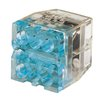
In-Sure™ Push-In Wire Connectors come in 7 varieties, so selecting the appropriate connector is easy.
2-Port
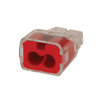
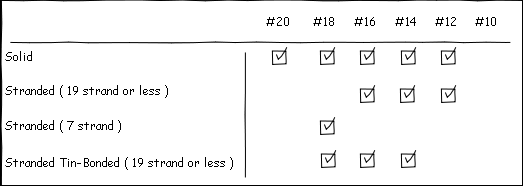
Acceptable Wire Sizes
3-Port
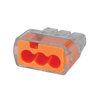
Acceptable Wire Sizes
3-Port Large
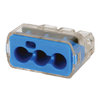
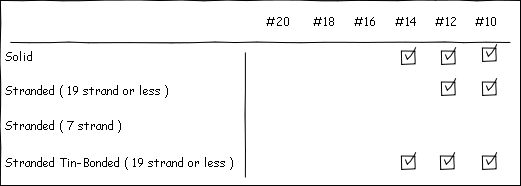
Acceptable Wire Sizes
4-Port
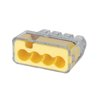
Acceptable Wire Sizes
5-Port
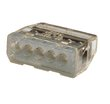
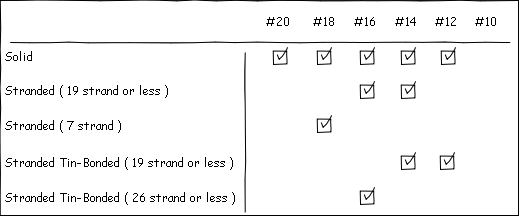
Acceptable Wire Sizes
6-Port
Acceptable Wire Sizes
8-Port

Acceptable Wire Sizes
Features
- No-twist connection reduces repetitive motion fatigue
- Low insertion force for fast and easy connections
- Compact size makes installation easy
- Clear shell gives visual verification of connection
- UL Listed to 486C and CSA Certified to C22.2 #188
- UL 467 Listed for grounding and bonding applications
- 600V maximum building wire, 1000V maximum signs and lighting fixtures
- Shell rated at 105 C (221 F)
Most old school electricians hate push connectors, due mostly to the crappy design of the first generation stab connectors on the back of receptacles. I, however, am more open minded, and will try anything that might make a job easier.
Once I got these things home, I did the only thing any reasonable and sane DIYer would do: I took one apart to see how they worked.
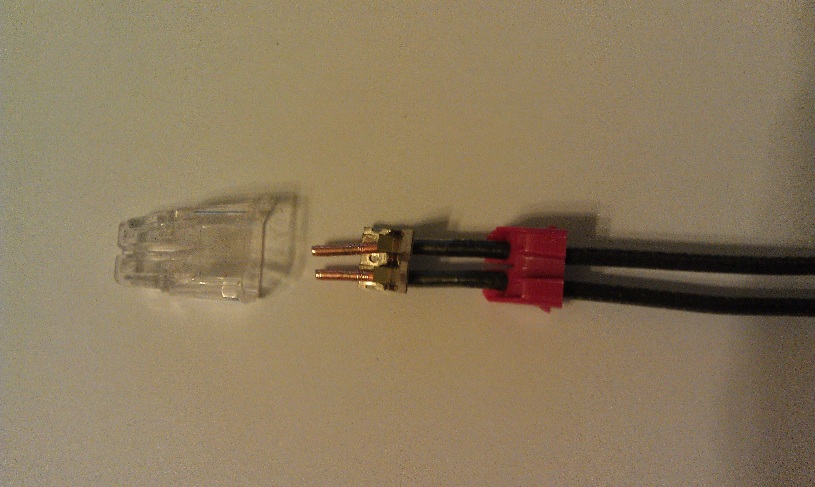
As you can see, they’re made up of three parts. The bushing (red), the contacts (metallic), and the insulating cover (clear).
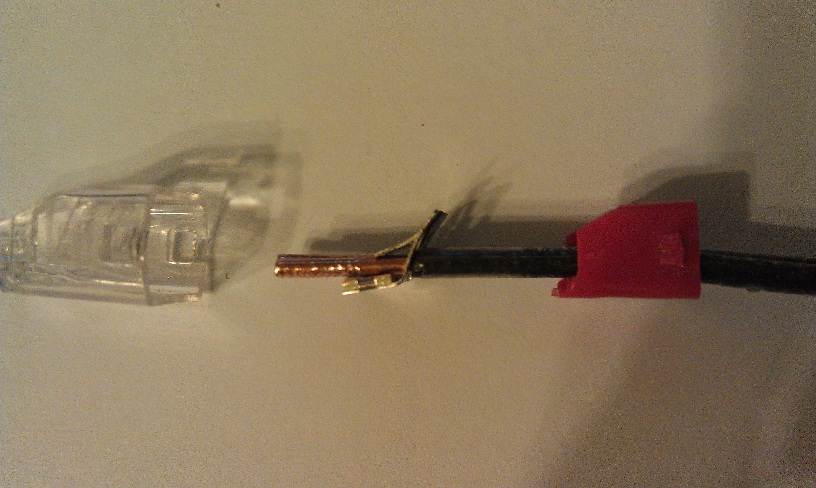
From the side, you can clearly see how the wires are held in place. And let me tell you, they are held in place really well. I yanked, tugged, pried, and pulled to try and get the wires to come out. So under normal circumstances, you shouldn’t have to worry about a wire slipping out. I did, however, find a way to remove the wires surprisingly easily. If you twist the wire back and forth while pulling, the wires will come right out. Doing so does damage the wire quite badly (you may be able to see the damage if you look closely at the above images), so it would have to be trimmed back and re-stripped before inserting it into a new connector. According to Ideal, twisting the wire to release it is a feature, not a bug.
When fully inserted into the connectors, the wires make a solid connection. So there should be no worry of resistive heating or arcing with these connectors.
Now I was satisfied the wires were not going to fall out, and I wasn’t going to burn down the house due to a bad connection. I decided to see how much time these things could save me in a typical situation. I wanted to see how long it would take to wire up a simple luminaire, first with traditional twist-on wire caps, then with push-in wire connectors.
The Setup
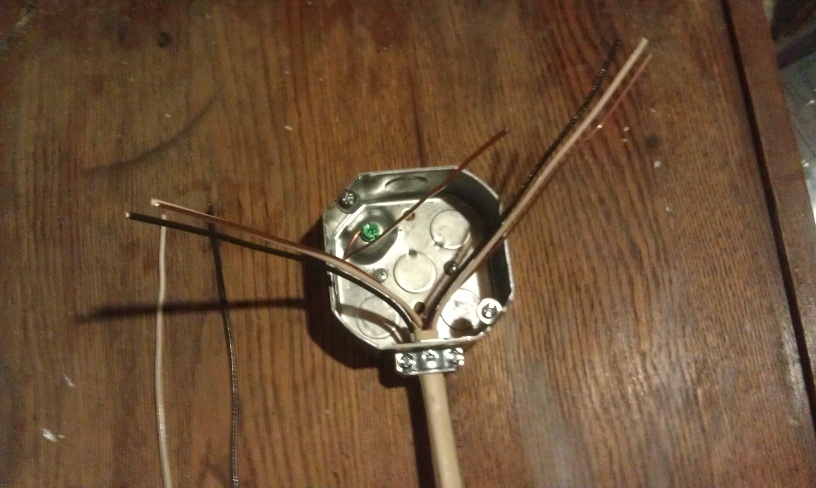
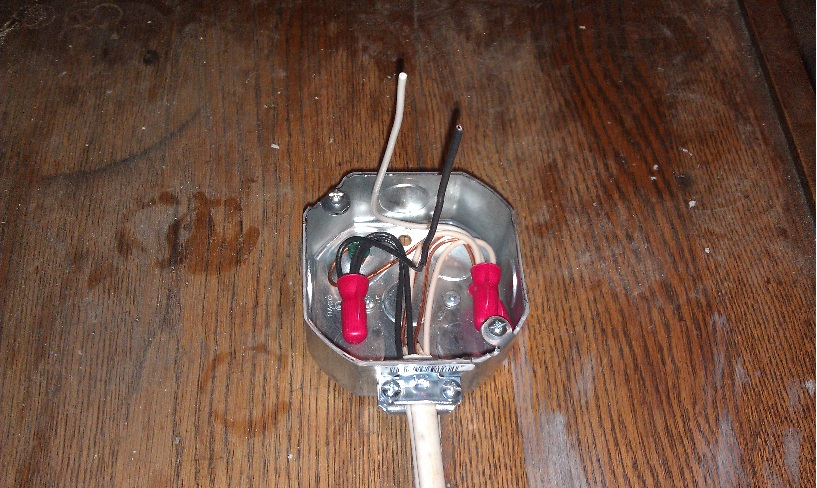
As you can see, I set up a typical scenario that electricians have seen many times. I have a feeder (from breaker), a feeder to the next fixture, and a couple pig-tails to connect the lamp holder.
Twist-on wire caps
The Procedure
- Strip wires.
- Twist wires together.
- Trim wires.
- Install wire cap.
- Repeat for each group of wires.
The Result
3:03.2
Push-in Wire Connectors
The Procedure
- Strip wires.
- Insert into wire cap.
The Result
1:50.5
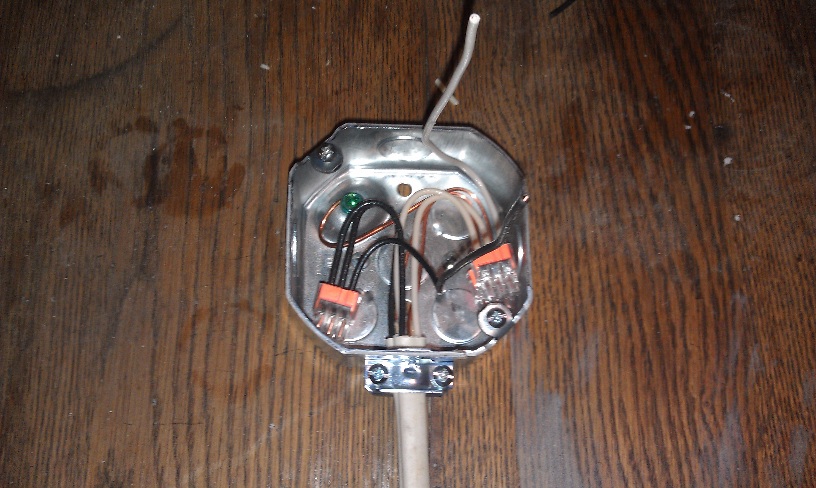
For each luminaire I could save over a minute, using push-in wire connectors. That could be quite a time saver, if I was installing 10-20 lights.
The only fault I could find is that the wires can easily be twisted out of the connector. I don’t think this is a major issue; since the wiring would likely not see that much motion, but it is a small issue that hopefully Ideal can work out. They do cost more than the run of the mill twist-on wire cap, but the installation time savings could easily render that moot. All in all, I’d say these are a pretty slick product. I give Ideal In-Sure™ Push-In Wire Connectors 4 Captain Constructions out of 5.


Filed under Tool Review Tools
Tagged: Electrical, review


Great review! Now I just need something to rewire…I love that a two dollar connector is going to be the driving force for installing a ceiling fan.
I use these a lot: http://www.homedepot.ca/product/can-twist-15pc-one-size-fits-all/945495
You don’t have to pre-twist, and its “one-size-fits-all” so you don’t have to go searching for the right size with most jobs. They are also extra deep so often you don’t have to trim either.
As far as I know, you don’t have to pre-twist with most modern wire nuts. The part that sucks is doing the twisting once you have 3 or 4 wires in the nut (and hope you don’t have one pop out while you are doing it.
I don’t think I will use these in place of all my wire nuts but when I need to connect more than 2 or 3 wires I think I might spring for these. I have to install a 4 light fixture in my bathroom and I have been putting it off because the fixture has a hot and neutral wire for each bulb so I need to connect 5 hots and 5 neutrals (4 lights + power). Using these things should make that a snap.
I love these things, been using them for several years now. I did all the electrical work in my parents new addition with these. They also work well when replacing ballasts in fluorescent lights. They don’t work with stranded wire, which is a bummer.
Thank you for the nice review of IDEAL’s In-Sure™ Push-In Wire Connectors. The “release mechanism” you mention in the article is actually not a release mechanism, but a test port. However, you are correct in stating that the conductors can be released with a twisting and pulling motion. This is by design to be able to remove the conductors if needed. Thank you again for your support of IDEAL! 🙂
I have used these push-in connectors to wire several houses. While skeptical at first, I am now a convert. They make for fast and compact connections. I like the clear plastic housing which allows visual confirmation that the wires are fully inserted. I find these push-in connectors are most useful when connecting larger numbers of wires (4-8). To connect that many wires with a twist-on cap is problematic – the twisted mass of wires becomes very bulky and the quality of the connection is not certain with twist-on caps. These push-in connectors solve both of those problems. In my experience, stranded wire does not work well with these push-in connectors. I continue to use twist-on caps for stranded wire connections. It is true that push-in connectors are more expensive than twist-on caps, but well worth the price in my opinion.
“Most old school electricians hate push connectors, due mostly to the crappy design of the first generation stab connectors on the back of receptacles.”
Somewhat true, a lot of tradesmen don’t like change in general. I’m a licensed master electrician, and do a lot of service work. First generation or fresh off the shelf, I have seen a lot of these push in type connectors fail in high current applications. (like space heater / microwave ovens)
The problem with these connectors is the small surface area that contacts the conductor. Over time, with conductor oxidization, a high impedance connection is created. this heats up the connector, and it fails. Keep in mind that most electrical contractors warranty their work for only one year. These are great in that situation, they make more money on a contract build, then we get to do more service work in the long run when they fail.
I consider myself a very open minded electrician, and I have installed many of these in new construction jobs. However, I would not install them in my own home or work that I could be held personally accountable for.
“However, I would not install them in my own home or work that I could be held personally accountable for.”
Uh yeah, sorry to break it to you but you and your license can be “held personally accountable” for any electrical work you do. Your business or the business of your employer can also be trashed beyond redemption on Yelp, Google places, etc when you piss off a customer with shoddy work. Let just one take to their facebook page about how you almost burned down their house and killed their kids with your poor quality work and the bad reviews will pour in so fast you won’t even be able to count them all.
I have read that everyone is twisting and pulling on wire to remove from connector, well I am doing some car radio work due to some speakers stopped working only have car for three months so removed stereo to find it’s been replaced and car harness was cut so short and installer used red crimp wire connectors to join car harness to stereo harness and trying to fit crimp tool into a mess of short wires wasn’t allowing for a good crimp and wires were just falling out of connectors, went to Homies and found these sexy push and lock connectors, creamed my pants and of coarse took it apart to see how it works and found that if you take a very small screw driver and slide it into square opening you will push on metal conducting plate that is pushing down on wires to hold them in place and as you easily push screwdriver in it releases plate or pushes up and away from wires and allows wires to slip right out or even better if your wire is very thin you can do this to allow the flexiblest of wires to go in with ease.
thanks i was wondering if you could use these for speaker wire.
Tryn to leave some pictures of screw driver into the connector. Does any one know how to paste pictures to this forum?
“With traditional wire caps, the wires would have to be twisted together (mechanically joined) before twisting on the insulating wire cap.”
Wrong. I can easily twist wires together tight enough using just a good quality wire nut that you will curse my name if you try to take them apart.
“Drop the old style wire nuts and go to Push In style connectors.”
The “old style wire nuts” have been securely joining electrical connections for decades and if done right the connection stays tight for decades. The push in ones? Who knows, until you find out with a fire from a loose connection. Backstab i.e. “push in” receptacles were all the rage when they came out and I have seen the connections on more of them fail than I can count. Few good electricians will backstab them, instead they take a little more time and use the screw terminals.
Screw connection with NUTs rely on cooper flexibility but it cannot be as durable as steel spring used in PUSH IN connectors. I agree that cross section of contact is limited and for high current connectors special attention needed. That is why in Europe is popular WAGO. It comes also with removable click spring – you can easily pull wire back from the connector by opening its izolated spring slit. It is flat and surface of contact is greater. Unfortunatly I can find it here only by Amazon 🙁
For thick wire 11 or 10 AWG only 3-port IDEAL 39 Model (blue) can be applied. 🙁 Voltage 120 V in USA instead of 220 – 230 V in Europe results in thicker wires because the current will be 2 time higher for the same power.
Peace…Leo53 and Steve I too am old school about electrical installs wire nuts are the best for splicing I always pigtail instead of using a receptacle as a means of a splice. However when faced with short , stubbie piece of conductor in a Jbox these push on splicers can be a big help. I think the manufactures should improve their product to address oxidation and arching. Maybe by putting inside anti oxidation paste. Also what about twisting conductors together then push on connector??